Showing posts with label Operating System. Show all posts

Dec 3, 2012

Cisco Live: Cisco Upgrades Catalyst Series of Switches

As the “workhorse family” of switches that stretches across the entire spectrum of enterprises, the Catalyst 6500 is in use by more than 25,000 customers, and one of the most important things Cisco kept in mind in this product refresh was to protect customer investment so they can continue to use the 6500 products they already have without having to do a complete rip-and-replace, said Scott Gainey, director of switching solutions at Cisco.
The new capabilities are supposed to help providers tune their network infrastructure for the anticipated proliferation of connected devices, growth of video traffic, cloud computing business models and increasingly mobile workforces without having to opt for costly upgrades.
What’s new on Cisco Catalyst 6500?
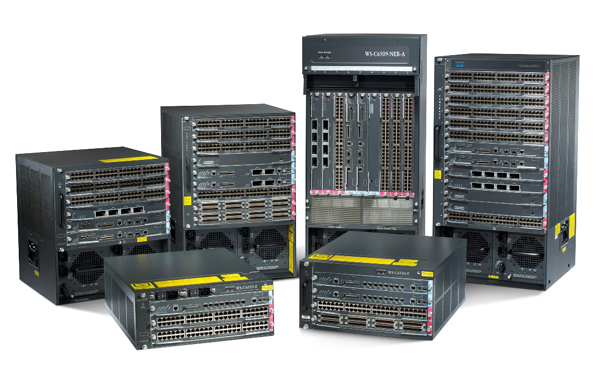
Cisco Live: Cisco Upgrades Catalyst Series of Switches
Supervisor 2T
At the heart of the Catalyst 6500 refresh is the Supervisor Engine 2T, a 2-terabit card that unlocks 80 gigabits per second per slot. The new SUP2T takes a 3x jump for the Catalyst 6500 series from 720Gbps to 2Tbps. To avoid forklift upgrades to existing 6500 customers, the SUP2T and line cards are fully compatible with all E-Series chassis models. Through backwards compatibility, it protects the investment of its installed base, but paves the way for 2Tbps of switching capacity and when deployed in a virtual switching system (VSS) configuration, will scale to 4Tbps. What does the ability to download 2 terabits in a second mean:  approximately 250 (1GB) Harry Potter DVDs(i.e.: 15,000 DVDs per minute).

Dec 2, 2012

How Router Interfaces get Their Names on Cisco Routers?

Where do Router Interfaces get Their Names?

Router interfaces get their names when the router boots. A “device discovery” takes place and the names of the interfaces are generated based on a predicable method. On fixed interface routers (like the older 2500 series routers) the interfaces will always be the same. However, on newer routers like 2600, 3600, 3700, and Cisco 2800 series routers, interfaces can be modular. That means that the interfaces are cards (modules) that can be “plugged into” the router in different slots. Some of these interfaces are on WAN interface cards (WIC) and some are on Network Modules (NM). Other router interfaces will be built right onto the router. The newer model routers have different names for some of these slots like enhanced network modules (NME) and high-speed WIC (HWIC). However, for the purposes

Dec 1, 2012

Four Modes to Access and Configure a Cisco Router

Cisco IOS Command SummaryFour Modes to Access and Configure a Cisco Router

The four modes for accessing and configuring a Cisco router are: user EXEC mode, privileged EXEC mode, global configuration mode, interface configuration mode
Each mode has a unique command set.
Four Modes to Access and Configure a Cisco Router
Purpose of each Mode
user EXEC mode is the initial startup mode.  A router configuration session can be initiated using terminal emulation programs such as Kermit, HyperTerminal, or telnet. 

privileged EXEC mode is the system administrator mode.  In this mode configuration files can be read, the router can be rebooted, and operating parameters can be changed.
global configuration mode is used to modify system-wide configuration parameters, such as routing tables and routing algorithms.
interface configuration mode is used to modify the Ethernet and serial port configurations.

Nov 29, 2012

Ten terms you should know in Operating Systems

There are 10 important terms that you must know it. When you finish read and understand the following terms you will find  7 multiple choice questions answer it and send your answers by email. let's start with the main term which is Operating system .


  1. Operating system: Is a set of programs that lies between application software and the computer hardware. System software means all programs related to coordinating computer  operation, including the operating system, Programing language translators , and service program.
  1. The kernel : most of which  remains  in memory,  is called  resident. The  kernel controls  the  entire operating system and loads into memory nonresident operating system programs from disk storage as needed.